Internal control: definition, objectives and key stakeholders

Simplify internal control management
Bring risks, controls and action plans together, and monitor your internal control framework day to day with Iskera.
What is internal control? Explore its definition, key objectives, stakeholders and the steps involved in building an effective internal control framework.
Internal control plays an essential role in organisational governance. Yet it is still often seen as a collection of administrative or financial checks. Its purpose is much broader: to safeguard activities, manage risks and help the organisation achieve its objectives.
Whether in an SME, an international group or a public administration, an effective internal control framework helps clarify responsibilities, make operations more reliable and prevent failures.
But what exactly does internal control cover? What are its objectives, and who is involved in implementing it?
Internal control: what exactly does it mean?
Internal control refers to all the measures, procedures and activities an organisation puts in place to manage its operations, limit risks and help achieve its objectives.
According to the reference framework published by France's financial markets authority (Autorité des marchés financiers, or AMF), internal control aims, in particular, to ensure compliance with laws and regulations, adherence to management's policies, the proper functioning of processes and the reliability of financial information.
It therefore goes beyond occasional checks. Internal control is embedded in the organisation's day-to-day operations through rules, clearly defined responsibilities and checks tailored to the risks it faces.
Its fundamental principle is that of reasonable assurance: no framework can eliminate every risk, but well-designed internal controls can reduce the likelihood or impact of risks materialising.
The 4 key objectives of internal control
Internal control serves several complementary objectives that help organisations maintain control over their activities and improve overall performance.
1. Manage risks and safeguard operations
One of its primary objectives is to prevent errors, fraud, incidents and operational failures that could affect the organisation.
This involves identifying risks, defining appropriate controls and implementing corrective measures when anomalies are detected.
2. Ensure reliable information and reporting
Management decisions depend on financial, operational and regulatory information that must be reliable.
Internal control helps ensure the quality, accuracy and availability of this information by reducing data-entry errors, inconsistencies and communication issues between departments.
3. Ensure compliance with applicable requirements
Organisations must comply with numerous legal, regulatory, contractual and internal obligations.
Internal control makes it possible to verify that rules and procedures are followed, document the checks performed and identify any gaps that require corrective action.
4. Improve process efficiency
Beyond risk management, internal control also helps improve how an organisation operates.
By clarifying responsibilities, identifying bottlenecks and eliminating redundant controls, it promotes better use of resources and more efficient management of activities.
Who is involved in internal control, and what are their roles?
Internal control is not the sole responsibility of a specialised department. It involves several stakeholders, each with complementary responsibilities at different levels of the organisation.
Senior management and governing bodies
Senior management plays a central role in defining and implementing the internal control framework. It sets the direction, allocates responsibilities and ensures that the necessary resources are available.
The board of directors, or the relevant governing body, oversees the framework and the management of risks.
Operational managers and employees
Operational teams are the first line of internal control.
They follow procedures, perform the controls built into their activities and report any anomalies. Managers ensure that these controls are carried out properly and take the necessary measures when problems arise.
Internal control should therefore be embedded in day-to-day processes, rather than treated as an additional activity disconnected from operational realities.
Internal control, risk management and compliance functions
Depending on the organisation's size and structure, specialised functions support operational teams in designing and managing the internal control framework.
In particular, they help define methodologies, formalise reference frameworks, coordinate control campaigns and monitor results.
They also consolidate information to give management an overall view of risks and control effectiveness.
Internal audit
Internal audit has a distinct role: to independently assess the effectiveness of governance, risk management and internal control frameworks.
Through its audit engagements, it identifies potential weaknesses, makes recommendations and contributes to the organisation's continuous improvement.
Unlike operational functions, internal audit is not intended to carry out day-to-day controls on their behalf.
The Three Lines Model: clarifying responsibilities
The Three Lines Model developed by The Institute of Internal Auditors (IIA) provides a reference framework for clarifying responsibilities in governance, risk management and internal control.
It distinguishes three levels of contribution:
• First line: business functions and operational managers, who manage risks and carry out controls in their daily activities.
• Second line: internal control, risk management and compliance functions, which provide expertise, guidance and oversight.
• Third line: internal audit, which provides independent and objective assurance on the effectiveness of these frameworks.
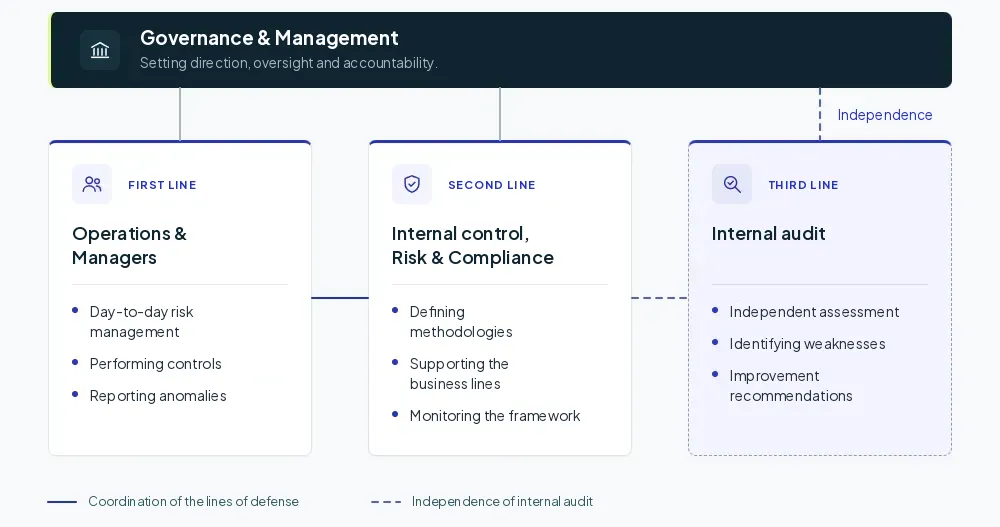
These three lines operate under the responsibility of senior management and the oversight of governing bodies. Coordination between them improves risk coverage, avoids overlaps and clarifies everyone's responsibilities.
From risk to control: how does it work in practice?
Consider the supplier payment process.
An organisation wants to prevent incorrect payments, duplicate payments and unauthorised expenditure. It can implement several controls: checking invoices, approving payments according to defined thresholds, segregating duties and matching invoices against purchase orders.
Each control has an owner, an execution frequency and supporting evidence demonstrating that it has been performed.
When an anomaly is detected, it must be analysed and, where necessary, followed by a corrective action plan.
This approach follows a continuous cycle: identify risks, define controls, verify their execution, analyse the results and improve the framework.
The challenge grows as the number of controls increases, particularly in multi-entity organisations. Information can become scattered across Excel files, email exchanges and shared documents, making monitoring and consolidation more difficult.
How can internal control become an ongoing management process?
Effective internal control is not simply a matter of having more procedures or carrying out more checks. What matters most is whether controls are relevant, properly executed and whether the organisation can make use of the results.
To achieve this, organisations need a common framework linking processes, risks, controls and responsibilities.
Digitalisation also makes it easier to roll out control campaigns, automate reminders, centralise evidence and track anomalies through to resolution.
With Iskera's internal control platform, organisations can centralise their framework, automate control monitoring and use up-to-date dashboards to manage their activities more effectively.
The aim is to move from an approach focused primarily on documentation to an operational, collaborative internal control framework that is continuously monitored.
This is why choosing the right internal control software matters: it simplifies teams' work and supports a process of continuous improvement.
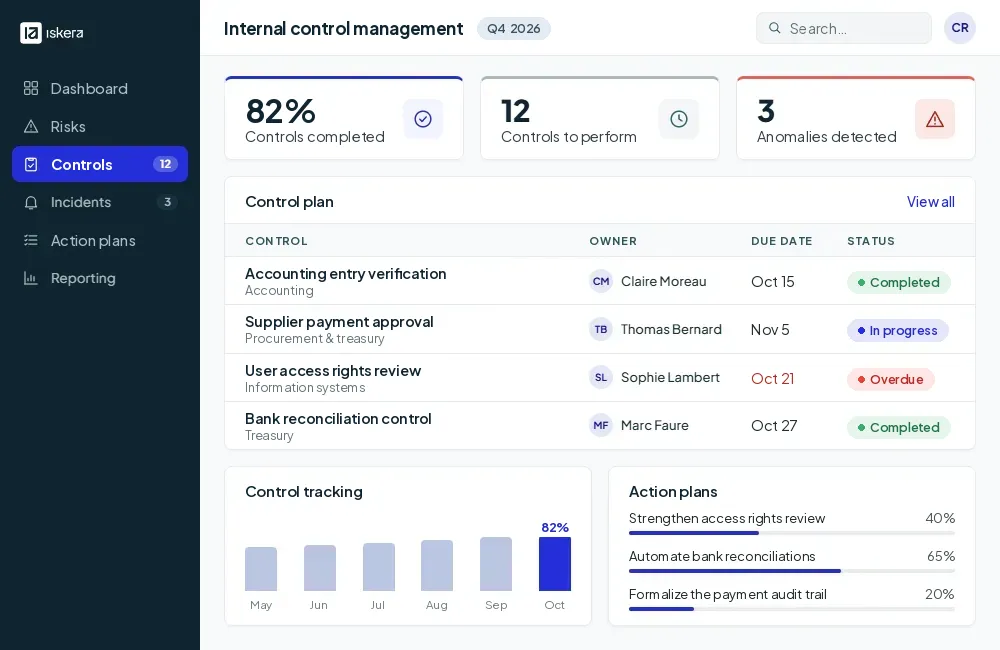
Internal control is essential to governance and risk management. It helps safeguard operations, ensure reliable information, maintain compliance and improve process efficiency.
Its success depends on the involvement of everyone, from senior management to operational teams, and on a clear allocation of responsibilities.
Simplify internal control management
Bring risks, controls and action plans together, and monitor your internal control framework day to day with Iskera.
Blog
Related GRC articles



Bertrand Rubio joins Iskera as Deputy CEO and Chief Operating Officer (COO)
The European GRC technology group is strengthening its executive team to accelerate growth, product innovation and expansion across Europe. Iskera announces the appointment of Bertrand Rubio as Deputy CEO and Chief Operating Officer (COO).