ISO 9001:2026: Key Changes and How to Prepare for the Transition

Prepare for ISO 9001:2026
Centralise your processes, manage risks and track improvement actions with Iskera's quality management software.
ISO 9001 is evolving after a decade without a major revision. Explore the key changes, transition deadlines and practical steps to prepare your quality management system.
The new ISO 9001:2026 standard was published on 16 September 2026. Ten years after the previous edition, this revision updates several requirements relating to quality management, process control and customer satisfaction.
While the fundamentals of quality management systems (QMS) remain unchanged, some requirements have evolved to better reflect the challenges organisations face today.
For organisations already certified to ISO 9001:2015, the transition must be completed by 30 September 2029.
What are the key changes, and how should your organisation prepare?
ISO 9001:2026: What has changed since 2015?
ISO 9001 is the international reference standard for quality management. It helps organisations structure their processes, control their operations and improve customer satisfaction.
The 2026 edition retains the core principles of ISO 9001:2015: the process approach, customer focus, the PDCA (Plan, Do, Check, Act) cycle and continual improvement. The requirements remain organised into Clauses 4 to 10.
This revision is therefore an evolution, not a complete overhaul. Organisations with an established QMS can build on their existing practices and focus on the requirements that have changed.
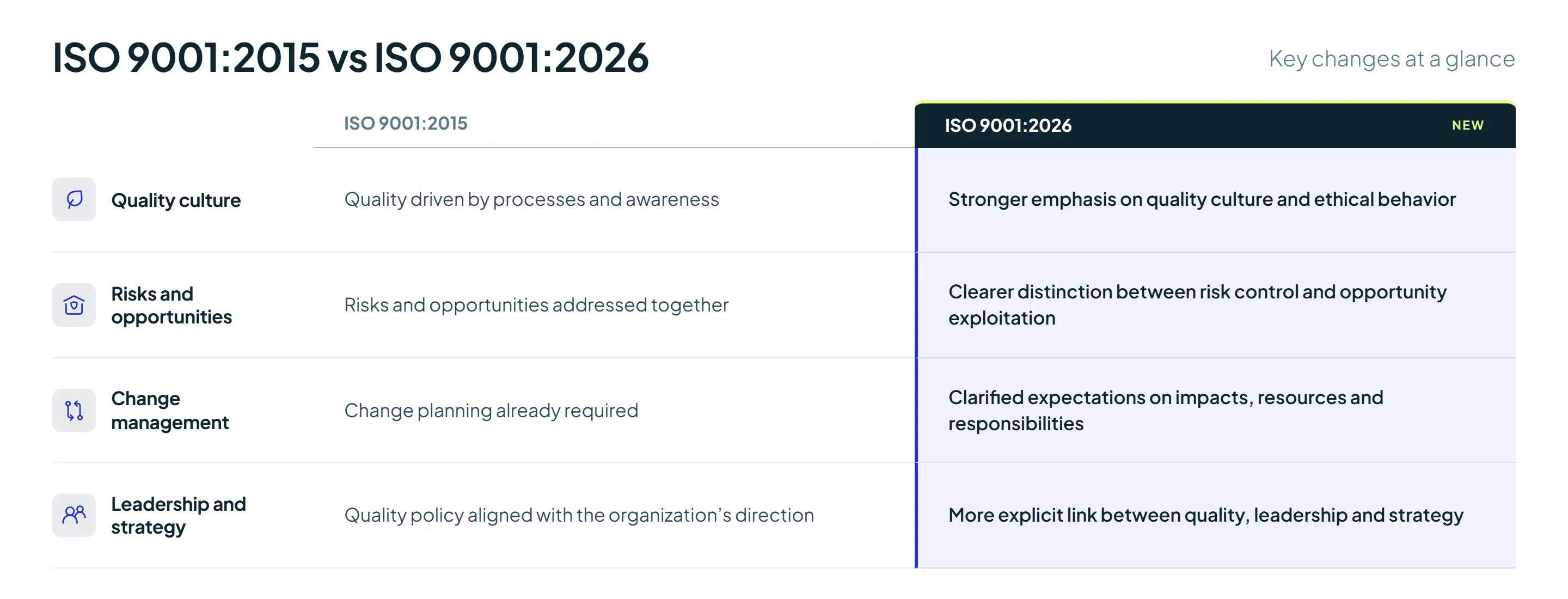
Three changes deserve particular attention.
1. Greater emphasis on quality culture and ethical behaviour
Relevant clauses: 5.1.1, 7.1.4 and 7.3
The 2026 edition places greater emphasis on quality culture and ethical behaviour. It reinforces top management's role in promoting these principles and helping employees embrace them.
The aim is to ensure that quality goes beyond documented procedures and is reflected in everyday decisions and behaviour.
Consider a manufacturing company where an operator identifies a nonconformity on a production line. If production targets discourage them from reporting it, the QMS has a weakness, even if a reporting procedure exists.
By contrast, an organisation that encourages transparency and the reporting of issues can address problems before they have more serious consequences.
For quality managers, this means focusing on:
- Raising employees' awareness of quality and ethical behaviour.
- Clarifying expected behaviours and responsibilities.
- Aligning management commitments with day-to-day practices.
- Encouraging the reporting of nonconformities and improvement ideas.
The challenge is to demonstrate, particularly during audits, that quality culture is genuinely embedded in daily operations.
2. A clearer distinction between risks and opportunities
Relevant clause: 6.1
Since 2015, ISO 9001 has required organisations to address risks and opportunities that could affect the intended outcomes of their QMS.
The 2026 edition clarifies this approach by drawing a clearer distinction between actions to manage risks and those intended to pursue opportunities.
This helps structure two complementary activities: anticipating threats to quality objectives and identifying ways to improve performance.
Example: A company facing recurring delivery delays may identify a risk of customer dissatisfaction, but also an opportunity to optimise its logistics processes.
Managing the risk could involve tighter controls and delivery alerts. Pursuing the opportunity might involve reorganising operations or automating certain tasks.
In both cases, the company needs to choose appropriate actions and assess their effectiveness.
For quality managers, this means taking a structured approach to identifying and assessing risks and opportunities, assigning responsibilities and monitoring results.
The aim is to make risk and opportunity management a practical decision-making tool, connected to processes, quality objectives and customer satisfaction. Monitoring corrective actions and improvements also helps evaluate their effectiveness.
3. Better control of changes
Relevant clause: 6.3
Internal restructuring, new software or changes to processes can disrupt a QMS when their consequences have not been anticipated.
Change planning was already part of ISO 9001:2015. The 2026 edition clarifies expectations concerning impact assessment, necessary resources and responsibilities.
When introducing new document management software, for example, an organisation needs to plan data migration, user training and continued access to up-to-date procedures.
The goal is to plan changes effectively while maintaining QMS performance and business continuity.
Other changes worth noting
Beyond these three developments, ISO 9001:2026 introduces additional clarifications.
Leadership and strategy receive greater attention, particularly the alignment of the quality policy and QMS objectives with the organisation's strategic direction.
Climate change is incorporated into the new edition following the 2024 amendment. Organisations need to determine whether it is relevant to their activities and consider any related expectations of interested parties. This does not mean every organisation must set environmental objectives within its QMS.
Finally, Annex A has been expanded to help organisations interpret and apply the standard's requirements in different contexts.
ISO 9001:2026 transition: Key dates
The publication of the new standard begins a three-year transition period for organisations certified to ISO 9001:2015.
Three key milestones should be kept in mind:
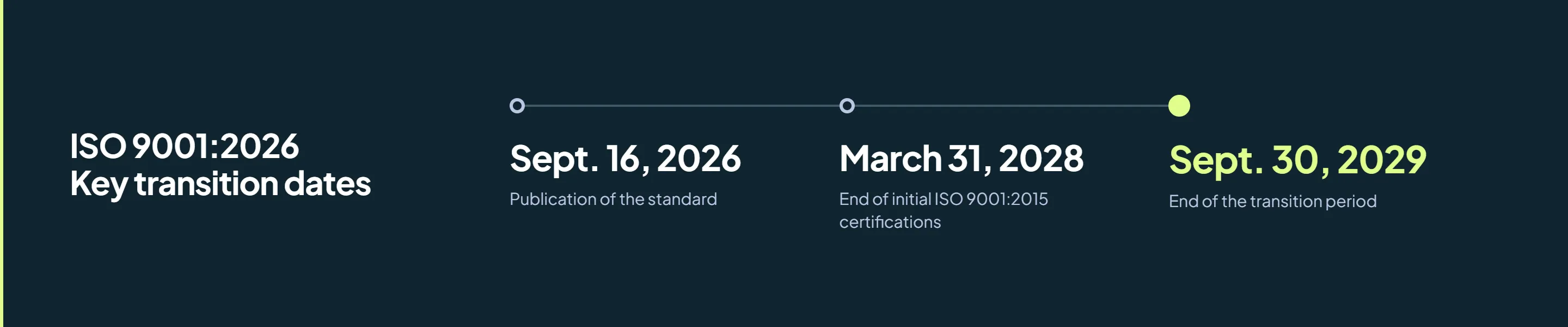
From 30 September 2029, certificates issued to ISO 9001:2015 will no longer be valid. Organisations wishing to maintain certification must therefore complete their transition to the new edition.
This can take place during a surveillance audit, a recertification audit or a dedicated transition audit, depending on arrangements with the certification body. Auditors will assess how the updated requirements have been addressed.
How to prepare for the ISO 9001:2026 transition
The transition is an opportunity to review existing practices and identify improvements that will make your QMS more effective. Five steps can help you organise the process.
1. Assess your current quality management system
Start by comparing the revised requirements with your current practices. A gap analysis helps identify priorities, check alignment with quality objectives and establish an action plan for your transition audit.
2. Update your processes and practices
Based on the assessment, adapt the relevant processes, methods and documentation. This could include improving how opportunities are monitored, clarifying responsibilities or strengthening employee awareness.
You do not need to rewrite every procedure: focus on the gaps you have actually identified.
3. Engage management and employees
Changes relating to quality culture and leadership require involvement across the organisation. Engaging top management and process owners helps set priorities, allocate resources and implement updated requirements.
Employee awareness and training for quality managers also help embed these changes in daily practices.
4. Use quality management software
The transition can also be an opportunity to modernise the tools used to manage your QMS.
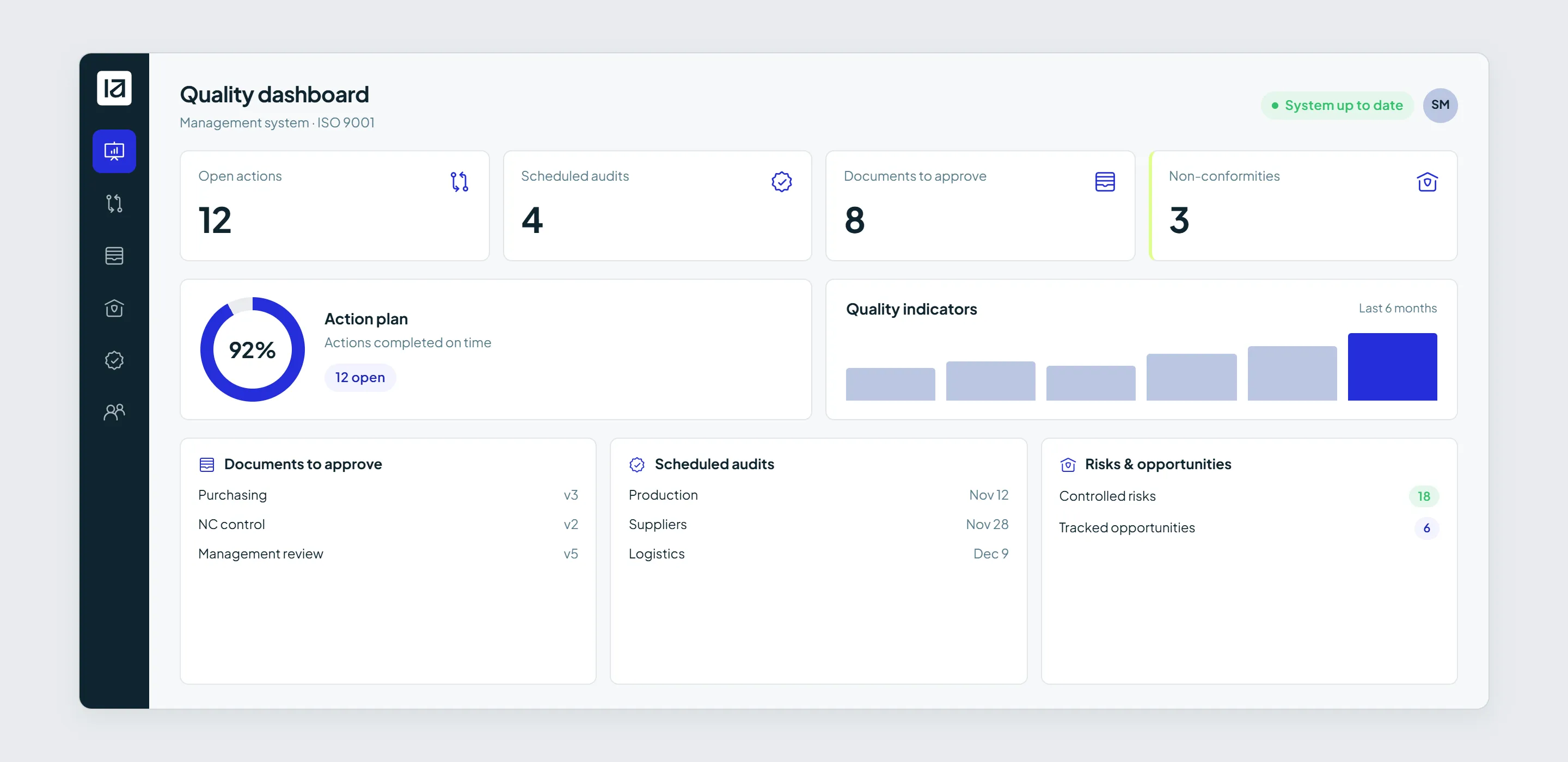
Quality management software that supports ISO 9001 helps centralise processes, manage documentation, monitor risks and opportunities and track improvement actions.
A solution such as Iskera brings these activities together in one environment, improving traceability and simplifying audit preparation. Quality managers gain a clearer, more up-to-date view of their management system.
5. Evaluate the effectiveness of your actions
Once the changes have been implemented, assess their effectiveness. Internal audits, quality indicators and management reviews help verify that updated practices are being applied correctly.
This final step also identifies any remaining adjustments before the transition audit.
How Iskera supports your ISO 9001:2026 transition
Under ISO 9001:2026, organisations must continue to demonstrate their ability to control processes, anticipate risks and improve performance.
Iskera helps quality managers structure and manage their QMS through an integrated platform that brings together processes, procedures, risks, audits and improvement actions.
Teams benefit from accessible, up-to-date and traceable information, making it easier to monitor requirements and prepare for certification audits.
The transition to ISO 9001:2026 is therefore an opportunity to strengthen the effectiveness of your QMS while simplifying its day-to-day management.
Blog
Related GRC articles

Bertrand Rubio joins Iskera as Deputy CEO and Chief Operating Officer (COO)
The European GRC technology group is strengthening its executive team to accelerate growth, product innovation and expansion across Europe. Iskera announces the appointment of Bertrand Rubio as Deputy CEO and Chief Operating Officer (COO).